
THANK YOU FOR SUBSCRIBING

Hrtech Outlook Weekly Brief
Be first to read the latest tech news, Industry Leader's Insights, and CIO interviews of medium and large enterprises exclusively from Hrtech Outlook


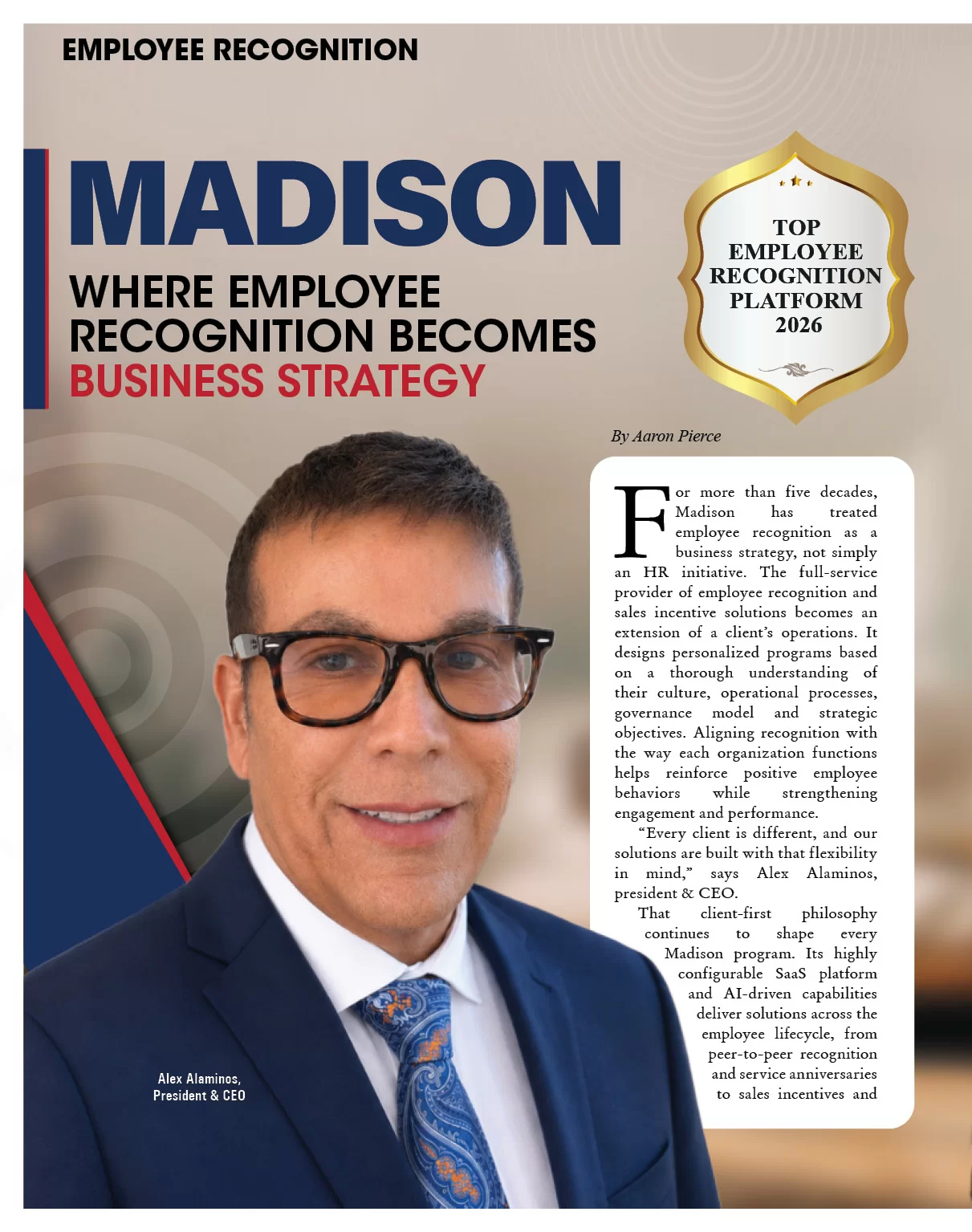
 Alex Alaminos, President & CEO and Akiko Valverde, Vice President, Product & Sales Engineering
“Every client is different, and our solutions are built with that flexibility in mind,” says Alex Alaminos, president & CEO.
That client-first philosophy continues to shape every Madison program. Its highly configurable SaaS platform and AI-driven capabilities deliver solutions across the employee lifecycle, from peer-to-peer recognition and service anniversaries to sales incentives and enterprise-wide engagement initiatives. Supported by 24/7 global service and a white-glove delivery model, these recognition programs evolve with changing organizational needs.
Madison’s flagship enterprise-grade cloud platform, Maestro, together with its mid-enterprise platform, Aria, gives organizations the freedom to move beyond the need to adapt to software templates and configure recognition programs around their own culture and business objectives.
A Customer-First Foundation
Founded in 1975, Madison has evolved from a performance solution provider into a global leader in employee recognition and incentives. Long before technology platforms for recognition became commonplace, it built its business by understanding how organizations motivate people. This foundation enabled it to reinforce desired employee behaviors and align them with an organization’s business objectives.
Madison introduced the industry’s first internet-based sales contest in 1995, bringing incentive programs online and enabling organizations to engage, track and reward sales performance through digital platforms.
Today, Madison combines a strategic consultative approach with configurable SaaS technology and AI-driven intelligence to serve enterprises from those that are growing to some of the world's largest employers. It supports more than five million users worldwide and delivers reward fulfillment across more than 160 countries under one, integrated platform.
 Although technology is a critical pillar, Madison’s customer-centric ethos ultimately shapes how it approaches every engagement. Each client relationship is treated as long-term and deeply contextual.
“Our business model has been very different since inception,” says Alaminos. “We don’t have a culture that looks at a client as a number.”
This approach has resulted in strong client retention and long-term continuity. Madison’s first client, which began working with the company 50 years ago, remains one of its largest. Many enterprise customers have maintained relationships with Madison for 15 to 20 years.
That continuity extends to the teams supporting each account, eliminating the need for clients to repeatedly adapt to new contacts. Long tenures with Madison results in team members with a deeper understanding of each organization’s needs.
Recognition Built into Moments That Matter
The Maestro platform makes recognition social, visible and continuous. Client employees can publicly celebrate achievements, comment on recognition received by colleagues, share video messages and reinforce organizational values through interactions.
Extending those capabilities are AI-powered tools in the Madison ecosystem that simplify the recognition experience.
“Recognition must become an integrated part of everyday work,” says Akiko Valverde, Vice President, Product & Sales Engineering. “It should be accessible wherever employees collaborate instead of requiring them to visit a separate platform.”

Every client is different, and our solutions are built with that flexibility in mind.
AI capabilities summarize activity and surface potential recognition opportunities by suggesting team members who may deserve appreciation, reducing the cognitive burden on managers.
Proving Business Value of Recognition Programs
Madison is also advancing the data-driven side of recognition through AI-powered analytics. Historically, recognition analytics have been retrospective, with reactive analysis of past data. Organizations are now able to proactively identify trends using predictive intelligence.
Its advanced analytics enables leaders to identify emerging trends, anticipate declining engagement and detect areas requiring attention before challenges become visible. They can proactively strengthen workplace culture through data-informed action. Through these data-driven insights, Madison creates happier work experiences.
Madison connects recognition to broader business outcomes, including retention, employee engagement, productivity, customer satisfaction, safety performance, sales growth, and other operational KPIs. Advanced analytics help clients identify which recognition behaviors are most strongly associated with positive business results.
Global Consistency with Local Flexibility
Meaningful experiences for a diverse workforce are delivered across different regions and populations. Global workforces span multiple languages, cultures, currencies, regulations and workplace norms. What resonates with an employee in Germany may not align with one in Singapore, Brazil or the U.S., making a one-size-fits-all approach difficult to sustain. Madison’s robust, client-focused, highly configurable, comprehensive multilingual platforms offer in-country solutions and global storefront infrastructure to strike a balance between global consistency and local flexibility.
Organizations can establish enterprise-wide recognition strategies built around shared values, behaviors, governance, impact assessment and reporting, while maintaining centralized administration, visibility and compliance across all regions.
Local teams can tailor communications, campaigns, workflows, reward catalogs, languages and user experiences to regional and cultural preferences, delivering authentic employee experiences without compromising global consistency. Madison’s platform is designed to integrate with broader HR ecosystems. For higher-value recognition awards, organizations can connect recognition workflows with payroll systems, enabling local currency processing while providing HR teams with deeper data, analytics and visibility into recognition outcomes.
The success of Siemens is an example of this strategy in action. The global technology leader sought to replace fragmented regional recognition programs with a unified global platform. That required a solution capable of delivering the data and analytics needed to measure recognition efforts and spending. It also faced highly specific local requirements, particularly in Germany and Switzerland, where works council regulations required employees to have options such as opting out of recognition or customizing communications.
 Madison developed a country-specific, highly flexible platform that accommodated localized requirements while maintaining a consistent global strategy. The solution supported localized billing across more than 100 countries through its global operating network while allowing each country to configure recognition experiences based on its distinct needs.
In Germany, where employee recognition had not been widely adopted, it became a notable success, with the program expanding across multiple Siemens units after rollout. Madison helped identify best practices for each region and configured country-specific workflows without compromising overall program consistency.
A 100 percent Employee Stock Ownership Plan company, Madison attributes much of its long-standing client retention to an employee-ownership culture.
As recognition evolves from reactive appreciation toward proactive culture management, Madison’s long-standing combination of configurable technology, strategic expertise and dedicated service positions it to help enterprises navigate the next chapter of workforce engagement.
How Does An Employee Recognition Platform Support Workplace Engagement?
An Employee Recognition Platform gives organizations a structured way to acknowledge contributions, reinforce desired behaviors and connect appreciation with business priorities. Effective platforms can support peer recognition, service anniversaries, awards, incentives and engagement programs while making recognition visible and continuous. Employee Recognition Platform capabilities become more useful when recognition is built into everyday workflows rather than treated as a separate HR activity. This can make appreciation more timely and give managers a clearer way to reinforce behaviors that matter to the organization.
What Sets Madison Apart As An Employee Recognition Platform Provider?
Madison combines configurable technology with program design and ongoing service. Its Maestro enterprise cloud platform and Aria mid-enterprise platform allow recognition programs to be configured around an organization’s culture, governance model and objectives rather than forcing teams into fixed software templates. Its programs also support AI-driven recognition capabilities and 24/7 global service, giving organizations room to adapt programs as needs change. Madison also emphasizes long-term account continuity, with enterprise relationships extending across many years.
What Features Should Organizations Evaluate In Recognition Software?
A practical evaluation should consider configuration, workflow integration, analytics, administration, reward management and global support. An Employee Recognition Platform should make appreciation accessible within the tools employees already use, while giving leaders visibility into participation, manager involvement, recognition frequency and alignment with organizational values. Integration with HR ecosystems and payroll can also matter when recognition involves local currencies or higher-value awards. Leaders can also examine whether recognition reaches different functions and reflects the values and behaviors the organization wants to reinforce.
How Can Recognition Programs Create Measurable Business Value?
Recognition becomes more useful when organizations can connect program activity with outcomes. An Employee Recognition Platform can help track adoption and identify patterns associated with engagement, retention, productivity, customer satisfaction, safety performance or sales growth. Predictive analytics can go further by highlighting emerging changes in engagement and areas that may need attention, helping leaders act before concerns become more visible. This shifts recognition analytics from a historical report toward a practical input for workforce and operational decisions.
How Can An Employee Recognition Platform Support Global Workforces?
Global programs need consistency while meeting local needs. An Employee Recognition Platform can centralize governance, reporting and administration while allowing local teams to adjust languages, communications, campaigns, workflows and reward catalogs. Madison supports this approach with multilingual platforms, in-country solutions and global storefronts. Its network supports local billing across more than 100 countries while maintaining a consistent recognition strategy. This helps organizations manage differences in culture, workplace practices and currencies across markets.
How Does Madison Apply Recognition To Everyday Work?
Madison brings recognition into the flow of work through social and AI-enabled features. Its platform allows employees to celebrate achievements publicly, comment on recognition, share video messages and reinforce organizational values. Recognition opportunities can surface through Microsoft Teams, Google Meet and Slack, while AI can suggest employees who may deserve appreciation. This approach helps make an Employee Recognition Platform a recurring part of workplace interaction rather than an occasional program. Embedding recognition into collaboration tools can also reduce friction and create more natural opportunities for appreciation during everyday work.
Company
Madison
Management
Alex Alaminos, President & CEO and Akiko Valverde, Vice President, Product & Sales Engineering
Description
Madison is a global employee recognition and incentives company that combines enterprise SaaS platforms, AI-driven analytics, and strategic consulting to help organizations build performance-focused cultures. Serving large enterprises worldwide, it enables configurable, locally relevant recognition programs while delivering measurable insights across engagement, productivity, retention, and broader business outcomes.